Endorsement: Vote NO on Measure RTM - Mercury News/East Bay Times
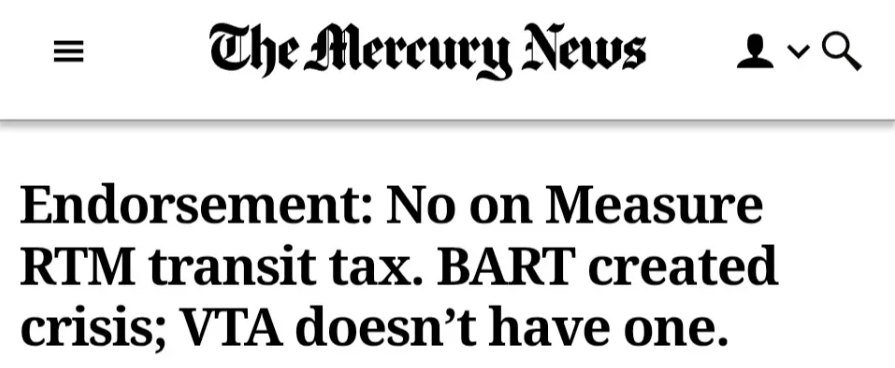
1. A Regressive Tax on Working Families
- "The initiative would increase sales tax rates above 10% in at least 50 of the 69 cities... Residents in at least seven of those cities would pay above 11%..."
- "Many Bay Area residents already struggle to make ends meet; they should not be asked to pay more taxes to those agencies that fail to maturely manage their budgets."
2. BART's Runaway Spending & Refusal to Cut
- "BART... serves about half as many passengers as before the pandemic. Yet it keeps running the same number of trains and its operating expenses... remain the same."
- "...rather than right-sizing service, BART leaders have accelerated toward a fiscal cliff... Measure RTM would enable BART to continue spending at about its current irresponsible pace."
- "If BART wants more tax revenue despite reduced ridership, it should first show good-faith effort to meaningfully trim ongoing expenses. It has refused to do so."
3. VTA Has No Shortfall & No Plan
- "Whereas BART claims it faces a 'fiscal cliff,' VTA confronts no such crisis..."
- "Simply put, this is not an agency in need of more money for operations... VTA has no concrete plan for how it would spend the new money."
4. Toothless Oversight: "Fox Guarding the Henhouse"
- "...overseen by a committee rife with conflicts of interest: Four of nine committee members are from the transit agencies under examination — think fox guarding the henhouse..."
The Verdict
"Opposing the initiative is not a vote against public transit. It's a demand for responsible financial management."
"...until BART begins to transparently right-size its operation and VTA demonstrates a need for new funding, neither deserves more money. Vote NO on Measure RTM."
Source: The Mercury News & East Bay Times Editorial Boards (October 9, 2026)
Watch our campaign videos
Our In-House Videos
No on RTM - It's Too Much
Don't buy the scare tactics.
We can fix transit without a massive new tax.
Supporters of the Regional Transit Measure claim voters must approve an unaffordable new sales tax to avoid severe cuts to BART, Muni, Caltrain and other Bay Area transit systems. But there is a better option.

The traffic catastrophe is a myth
Transit won't shut down if this measure fails. The state and agencies have billions in revenues and reserves they can use to keep trains running while forcing agencies to fix their management.
Read the details
Proponents claim a traffic catastrophe if the measure fails but they assume 25% of riders will abandon transit even if it keeps running. People and companies will adapt. A NO vote does not mean dead trains and endless traffic. It means forcing transit agencies and state government to act responsibly.
The state legislature has both the authority and the existing progressive tax revenues to fund transit operations directly just as Massachusetts now does. The only reason they haven't is because it is easier to pass the buck and dump a massive regressive sales tax on the entire Bay Area.
It is time to make our elected leaders in Sacramento do the work of prioritizing transit with the money they already have. We should use existing state resources to keep transit moving for the next couple of years until leaders deliver a plan that doesn't unfairly burden working families.
Start with the $6.2 billion transit already gets
Before any of this, start with the money already on the table. Bay Area transit operators already take in over $6 billion in tax, toll and government grant support every year.
Read the details
In fiscal year 2024-25, Bay Area transit operators took in roughly $6.2 billion in tax, toll and government grant support across the five counties. State and local officials should figure out how to get people where they need to go with that money before demanding more.
| Operator | FY2024-25 support |
|---|---|
| VTA (Santa Clara) | $1,707M |
| BART | $1,632M |
| SFMTA / Muni | $1,422M |
| All other operators (AC Transit, Caltrain, SamTrans, ferry, small East Bay) | $1,481M |
| Total | ~$6,242M |
Use High-Speed Rail $ and transit capital funds as a temporary bridge
The Legislature has the power to divert High-Speed Rail money and pause costly megaprojects to protect everyday commutes and balance agency budgets.
Read the details
The state can divert some of the $1 billion it spends on High-Speed Rail to fund local transit operations. It should do so. Whether or not cap-and-invest money goes to the bullet train in 2027 and 2028, there is no prospect of high-speed trains reaching the Bay Area before 2038.
Get more money to balance transit agency budgets by pausing two other costly capital projects in the Bay Area:
- BART Silicon Valley Phase II would extend BART six miles through downtown San Jose to Santa Clara at a cost of $12.75 billion. Service would not begin until at least 2037 and if Phase I is any indication few people will ride it.
- The Portal, the proposed downtown San Francisco rail extension connecting Caltrain to the Salesforce Transit Center, has a federal cost estimate of $8.25 billion for just 1.3 miles which commuters can easily cover by switching to Muni, biking or walking. Projected start date is 2036.
The Yes side says that money budgeted for construction cannot simply be spent on operations. But the Legislature can change that restriction and it has already done so. In 2023, Senate Bill 125 distributed $4 billion through the Transit and Intercity Rail Capital Program with explicit flexibility to use the money for either transit operations or capital improvements.
This would not have to become a permanent funding model. Capital-to-operations flexibility could instead provide a two-year bridge while the region works on a longer-term solution.
Use excess cash reserves agencies already have
Transit agencies also have substantial amounts of cash and investments already on their balance sheets.
Read the details
That does not mean all of this money is available to cover operating deficits. Some cash is legally restricted for debt service, capital projects, grants, pensions and other purposes. Agencies also need working capital to pay employees and vendors and maintain prudent operating reserves.
But the amounts are large enough that policymakers should determine how much is genuinely available before concluding that a new 14-year tax is the only way to maintain service.
According to BART's fiscal year 2025 year-end financial report, the agency held approximately $1.05 billion in cash and investments as of June 30, 2025. BART classified about $982 million as unrestricted and $70 million as restricted. Most of the unrestricted total was associated with capital funds but BART's General Fund alone contained approximately $391.5 million of unrestricted cash and investments.
BART itself explains that restricted money is limited by statutes or regulations to specific uses while unrestricted funds can be used for general operating purposes. That does not mean BART could prudently spend its entire unrestricted balance. It does mean that the amount of immediately available liquidity should be part of any discussion of how to bridge a temporary operating deficit.
Merge 27 overlapping transit agencies
The Bay Area can no longer afford 27 different transit agencies each with overlapping management, high-paid executives and their own administrative bloat.
Read the details
If New York City can combine all its agencies into one, shouldn't the Bay Area make some consolidations to fix this before asking for more funding?
A NO vote creates leverage to demand the reforms the agencies have avoided: merging overlapping agencies to cut administrative cost and management pay, replacing the lowest-ridership routes with subsidized on-demand service, transferring historic and specialty services to private operators, increasing the use of part-time operators, reducing layers of management and creating a genuinely independent inspector general for Bay Area transportation. None of this is in the measure. All of it should come before another 14-year tax.
Reduce transit's structural costs
The transit system was built for a world that no longer exists. A two-year bridge buys time to establish an independent Inspector General to conduct audits and adapt to post-pandemic realities.
Read the details
Ridership has been dropping for over a decade, yet agencies continue to spend more to do less. The decline has been apparent since 2001 in per capita terms and 2016 in raw numbers.
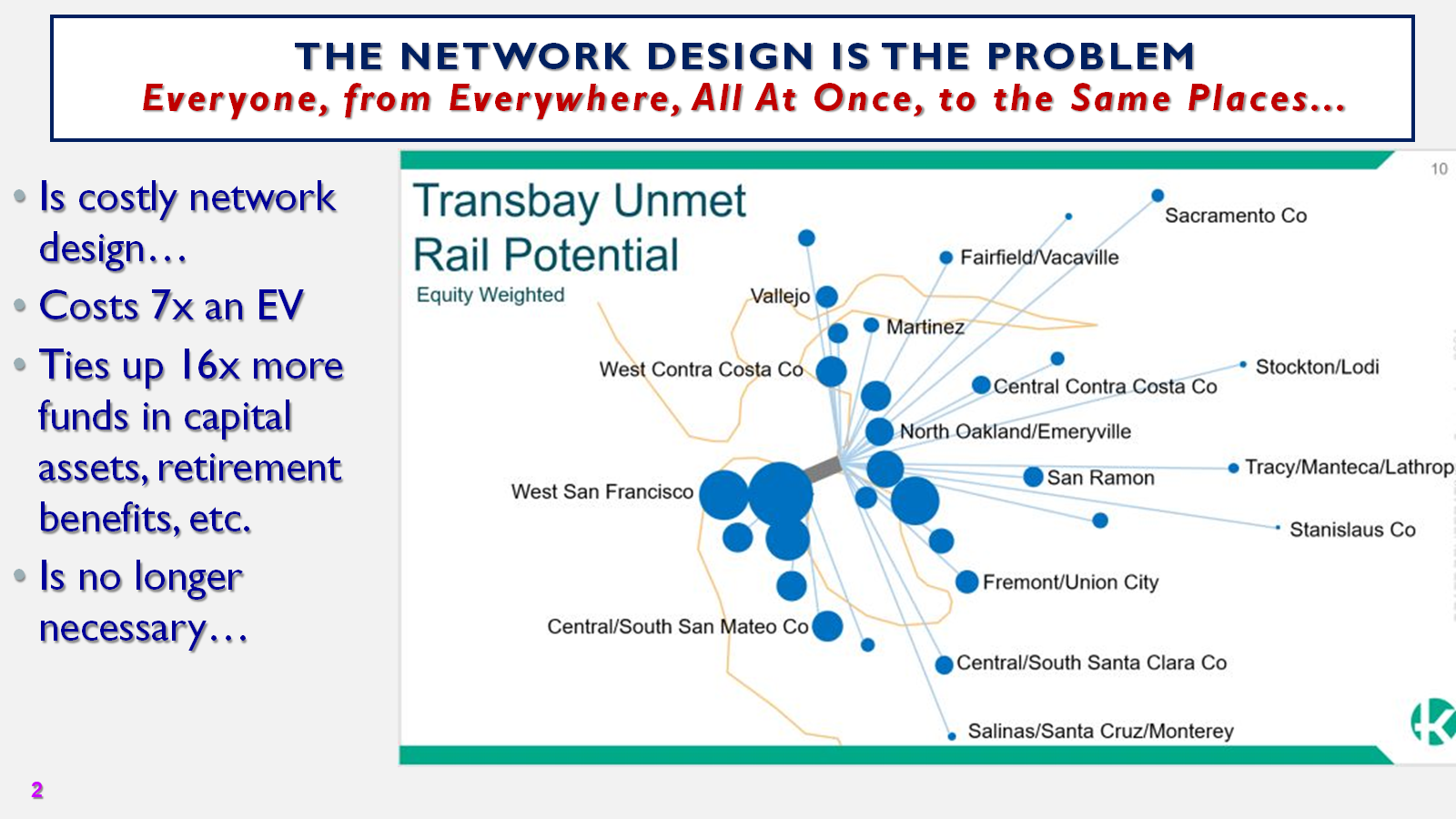
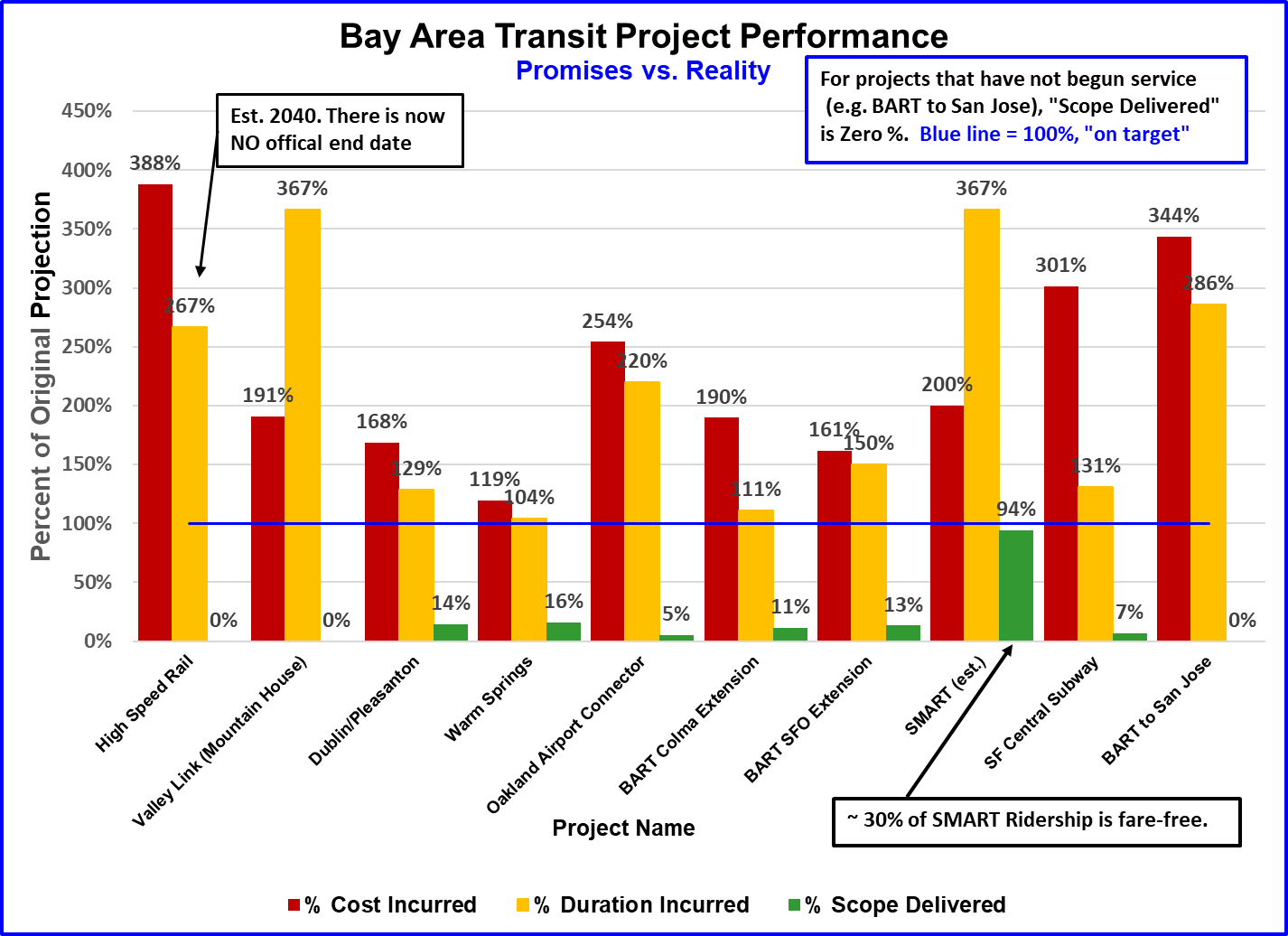
Moving capital money or drawing on reserves to pay operating expenses is not a permanent solution, but it buys time. A two-year bridge could give transit agencies and regional officials an opportunity to address expenses that a 14-year stream of new sales-tax revenue might otherwise leave unchanged.
Begin with establishing an Inspector General office above the MTC and all agencies funded independently and reporting to the State. Have that office conduct forensic and performance audits of all agencies. Currently only one major Bay Area transit agency has an IG (BART) and she quit because she was blocked from doing her job—after she found fraudulent billing by the co-author of the SPUR Carmageddon report. The findings of those audits will inform the rest of the reforms required to provide public transit efficiently.
That review could include:
- reducing duplicative administrative and management costs across the Bay Area's numerous transit agencies
- examining whether agencies can share functions or consolidate where doing so produces genuine savings
- reviewing work rules, overtime, executive compensation and long-term benefit costs
- replacing lightly used fixed-route service where appropriate with smaller vehicles, microtransit or on-demand transportation
- considering competitive contracting where it can provide service more efficiently
- preparing for autonomous buses, trains and other vehicles that could change transit operating costs during the next 14 years
The technology issue is especially important. Autonomous passenger vehicles already operate commercially in the Bay Area while autonomous buses and shuttles are being tested elsewhere. A transportation funding plan extending well into the 2040s should take into account the possibility that transit technology and cost structures will change substantially during that period.
Come back with a better long-term plan with greater accountability
After two years of bridging deficits and pursuing operating reforms, policymakers would have much better information about what Bay Area transit needs and what taxpayers can afford.
Read the details
And they would have two more years of evidence about autonomous transportation and other technologies that could reduce the cost of providing mobility.
If transit still needs additional dedicated revenue at that point, policymakers could return with a more targeted proposal and evaluate alternatives to a general sales tax including their distributional effects on households at different income levels.
The resulting funding plan should also tie additional revenue to measurable operating and financial objectives rather than establishing a fixed revenue stream for 14 years before those reforms are completed.
They have millions. We have you.
PG&E, billionaires, large companies and out-of-state transit contractors are spending millions to force a massive 14-year regressive tax on working families. We are an entirely grassroots movement fighting to stop them. We cannot win without resources to get the truth out to voters before election day. If you believe in fixes before funding, please chip in right now to help us defeat Measure RTM.
Sources: California Air Resources Board cap-and-invest expenditure reports; California High-Speed Rail Authority business plans; VTA BART Silicon Valley Phase II and Caltrain Portal project pages; and the SHIFT Bay Area analysis, The Transit Bail-Out Sales Tax: Fixes Before Funding (2026).